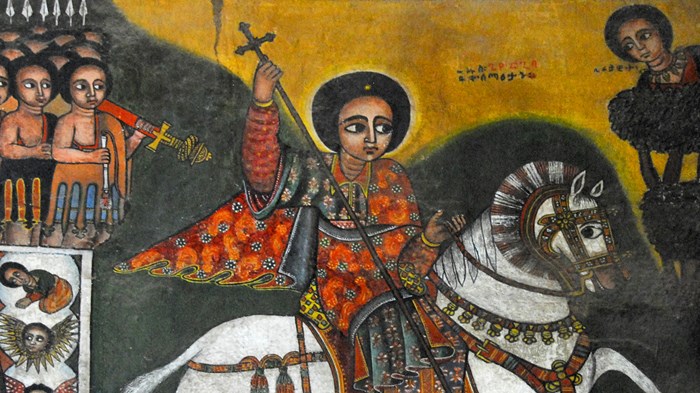
The
two Christian missionaries that showed up in the ancient northeastern
African empire of Axum in the fourth century could not have been more
unlikely. Kidnapped while traveling with a relative, the two young
brothers were brought as slaves to the royal family’s household. But
within a few years, an unexpected chain of events cast religious and
political power into their hands. While the region had been familiar
with Christianity for decades, the religion was soon to spread across
Axum. Indeed, the brothers’ relationship with the kingdom’s future kings
and their passion for spreading the gospel would alter the history and
religious composition of what is now modern-day Eritrea and Ethiopia.
Today, the Ethiopian Orthodox Tewahedo Church these young men founded more than 15 centuries ago has survived estrangement
from Rome, the spread of Islam, and repeated colonialization attempts.
In a continent where Western Protestant theology and Catholicism looms
large, the history of this institution offers a look at African
Christianity that has existed for nearly as long as the church has
itself.
A Great Power of the Ancient World
At
its height, the Axumite Empire (A.D. 100–940) was one of the four great
world powers along with Persia, Rome, and China. Due to its proximity
to the Middle East, its strategic location adjacent to the Red Sea, and
its open and outward-looking civilization, it played an important role
in regional affairs. Between the third and the sixth centuries, the
kingdom enjoyed control over large areas encompassing modern-day
northern Sudan, southern Egypt, Djibouti, Yemen, and southern Saudi
Arabia.

Image: Wiki Media
Axum
was a wealthy empire known for its sophisticated irrigation, masonry,
and its unique currency. Indeed, archeologists have discovered Axumites
coins as far away as India. But the country’s commercial interests went
even further—extending as far as China. Axum also drew the respect of
the Roman Empire. By the fourth century, the relations between
Byzantines and Axum become so significant that Constantine proclaimed
equal treatment of Axumites and Romans.
Axum
was also known for its writing system. Today, Eritrea and Ethiopia have
the distinction of being the only two countries in Africa which use
their own indigenous writing system: the Fidel (Geez). In fact, one of
the earliest translations of the Bible was in Geez, a Semitic language,
which is still used in Eritrean and Ethiopian liturgies. While not part
of the biblical canon, the book of Enoch is only wholly extant in the
Geez language. In the fourth century, Geez became the first Semitic
language to be vocalized, a process where a sound/letter is turned into a
vowel. (Much later, Semitic languages Hebrew and Arabic developed their
own linguistic conventions to represent vowels.)
Axum
was also respected for its justice-oriented political system. The
Abyssinians (who we know today as Ethiopians and Eritreans) were known
by the Greeks and Arabs as people of justice. Herodotus called them “the
most just men.” Centuries later, when the first Muslims faced
persecution, the prophet Muhammad instructed his followers to, “go to
Abyssinia, for the king will not tolerate injustice and it is a friendly
country, until such time as Allah shall relieve you from your
distress.” The third caliph, Osman, was among the refugees.

Image: Library of Congress
Abyssinia
was also an early home to the three Abrahamic religions: Judaism,
Christianity and Islam. Judaism entered Abyssinia with the Queen of
Sheba and later with Jewish exiles and merchants from Yemen and Egypt.
(The Jewish community still exists today, although many emigrated to
Israel in the 1980s.) One of the earliest Christian baptisms recorded in
Scripture was the Ethiopian eunuch in Acts 8 who took his new faith
with him to his homeland. Islam came to Axum before it went to its
second holiest city, Medina. This migration is known as the First Hijra,
when Muhammad’s first followers fled persecution in Mecca.
Christianity Comes to Axum
In
A.D. 316, two brothers, Frumentius and Aedesius, were sailing on the
Red Sea with their uncle Meropius, a Christian philosopher from Tyre.
Earlier that year, the Romans had infringed on a treaty that allowed
them to use the port of Adulis. So, when Meropius’s ship came to port,
Abyssinian locals massacred the entire crew, only sparing the brothers
so they could take them as slaves. The brothers became part of the royal
household where they earned King Ella-amida’s trust as gifted teachers
and administrators. In time, the king named Aedesius his cupbearer and
Frumentius his treasurer and secretary. Ella-amida died shortly after
the birth of his sons Ezana and Se’azana, leaving much of their care in
the hands of his queen and his two trusted servants, who would introduce
the young royals to Christianity.

Image: Library of Congress
While
Axum’s royal family was encountering Christianity for the first time,
the faith had long existed in the region. There are oral and written
traditions that show that early church fathers Mark, Matthew, and
Bartholomew preached the gospel in Abyssinia. As noted above, the Book
of Acts recounts the story of an Ethiopian eunuch who is baptized by the
apostle Philip and returns home to evangelize his countrymen.
Further,
the port of Adulis, located on the coast of modern-day Eritrea, was the
primary transit harbor between Byzantium and India and, as such, had
many interactions with Christian merchants. While the number of
Christians that existed in Axum in the fourth century is unknown, one
can infer that small pockets had existed, particularly in the urban
areas. Before his consecration as the first bishop, as treasurer and
advisor to the Queen Regent, Frumentius encouraged these urban
Christians to evangelize and practice their faith openly.
In
A.D. 328, Frumentius was consecrated as the first bishop of Axum by
Athanasius, the 20th Patriarch of the Church of Alexandria. Frumentius’s
new role made Axum the second official Christian state in the world,
following Armenia’s lead roughly 25 years after the Eastern European
country adopted the faith. (Axum also made this decision more than 50
years before Rome.) Frumentius baptized the two brothers he had helped
raise, both of whom would become kings of Axum. Under the rule of Ezana,
the first brother to become king, Axum also became the first in the
world to engrave the sign of the cross on its currency.
Once
Christianity was adopted by the royal family, it quickly spread
throughout the empire. Frumentius built several churches and traveled
throughout the country to evangelize, chronicled in his hagiography, Gedle Abba Selema.
Like the story of the beginning of Christianity in other regions, the
faith first took root in the urban, commercial, and political centers
and then moved outward to the rural areas.
Axumites
were already familiar with the idea of monotheism. Christ’s
revolutionary and yet conservative teaching in Matthew 5:17—“Do not
think that I have come to abolish the Law or the Prophets; I have not
come to abolish them but to fulfill them”—might have resonated with
Abyssinian Jewry.
American scholar W. L. Hansberry, in his book Pillars in Ethiopian History, quotes Sir Francis B. Head, a British officer, who aptly captured the spread of Christianity in Abyssinia.
“Never
did the seed of Christian religion find more genial soil than when it
first fell among the rugged mountains of Abyssinia … no war to introduce
it, no fanatic priesthood to oppose it, no bloodshed to disgrace it;
its only argument was its truth; its only ornament was its simplicity;
and around our religion, thus shining in its native luster, men flocked
in peaceful humility, and hand in hand, joined cheerfully in doctrines
which gave glory to God in the Highest, and announced on earth peace,
goodwill toward men.”
The
absence of Christian persecution sets Axumite Christianity apart from
those in the Greco-Roman world, where the faith was perceived as a
threat to the existing order. But in the case of Axum, the kings
themselves had been brought up in the faith and consequently did not
feel as though Christianity was an outside force thrust upon them.
A Maturing Church
Christianity
heralded a new age in Abyssinia—the birth of advanced learning. A new
class of people emerged fully devoted to learning and the cause of
Christianity. As the first vocalized Semitic language, Geez simplified
and improved reading and writing. The biblical translation that started
in the fourth century set in motion other literary works in philosophy,
history, and medicine. Instead of writing on stones and papyri, scribes
turned to leather, a more portable medium that enabled more Axumites to
learn to read and write.
In recognition of this transformative era, Frumentius, the first metropolitan bishop of Axum, was fittingly renamed Kesate Birhan (revealer of light) and Aba Selama (father of peace). The two royal brothers, Ezana and Se’azana, became Abreha (one who lit light) and Atsebeha (one who brought the dawn) during their consecration.
As
the church grew, it dovetailed its Christian heritage with its unique
cultural and social settings, developing an indigenous form of
Christianity with strong Judaic overtones and its own cadre of saints.
Some of the most prolific were the Nine Saints, a group of missionaries
who hailed from such cities as Antioch, Constantinople, Asia Minor,
Rome, and Caesarea and arrived in Axum and played an important role in
spreading the gospel at the end of the fifth century. Widely referred to
as the Second Evangelization, the arrival of these men helped to
solidify an indigenous Christian and African identity. Their
accomplishments included completing the biblical translation into Geez
initiated by Frumentius and writing the historical and philosophical
books which became the bedrock of Abyssinian cultural identity.
Shortly
after the arrival of the Nine Saints, Axum’s best-known king ascended
to the throne. Kaleb secured a name for himself by protecting Nestorian
Christians from persecution. The besieged community, which resided in
Yemen and Southern Arabia, lay vulnerable after the region’s ruler Yusuf
Dhu Nuwas converted to Judaism and sought to avenge Jews who had
suffered under successive Christian rulers of the Roman Empire. When the
Roman cities fell under his control, he gave the people the chance to
convert to Judaism or face extermination. Moved by the plight of other
Christians, Kaleb sent his army to rescue these Christians and his men
ultimately defeated Dhu Nuwas. His victory earned Kaleb the nickname
“Protector of the Faith.”
Axum’s decline
The
seventh century marked the beginning of the end for Axum. The
disruption of the Red Sea commerce, the Beja invasion which pushed the
Axumite frontier further south, and, perhaps most significantly, the
rise of Islam contributed to the decline of the empire.
Muhammad
had singled out Axum early on as a place that might be amenable to
Islam, believing that its monotheistic beliefs would make it easier for
Abyssinians to embrace Islam. He sent a letter to the Abyssinian king
emphasizing the prophethood of Jesus and the virginity and purity of
Mary. While some Christians did convert, most did not. According to Pew Research Center, Muslims currently make up about 37 percent of Eritrea and 35 percent of Ethiopia.
Today,
the Tewahdo Church has the most adherents of all the Oriental Orthodox
churches and is second only to the Russian Orthodox in size among all
Eastern Orthodoxy. (Most of the Oriental churches were eclipsed by the
Muslim Crescent and their adherents relegated into minority status.) The
Tewahdo Church, however, stayed autonomous despite its centuries-long
isolation from the rest of Christendom. The topography of the country,
the readiness of its peoples to defend its heritage, and its relatively
friendly relations with Islam enabled Abyssinia to maintain its
sovereignty.
This
isolation may also have contributed to a theological rift between the
Tewahdo Church and the rest of Christianity. The Tewahdo Church (whose
name means “being made one” in Geez) follows the Coptic Orthodox belief
in the complete union of divine and human natures into one perfectly
unified nature in Christ. This view, deemed heretical by Western and
Eastern churches at the Council of Chalcedon in 451, is maintained today by the Copts, the Tewahdo, and other Oriental Orthodox churches. While this view is condemned by
Protestants, Catholics, and Eastern Orthodox Christians, it serves as a
doctrinal indicator of the autonomy and independence of this venerable
African church.
The
Tewahdo church is the oldest and most venerated institution in Eritrea
and Ethiopia. Its presence hasn’t only preserved and built up
Christianity—it has created a repository of art, music, culture, poetry,
and literature. While Christianity is no longer the official religion of these countries, the Tewahdo church continues to guide the moral, spiritual, and intellectual lives of its more than 45 million adherents.
Semere T. Habtemariam is the author of two books: Reflections on the History of the Abyssinian Orthodox Tewahdo Church and Hearts Like Birds. He was born in Eritrea and came to the US as a refugee. He lives in Carrollton, Texas.